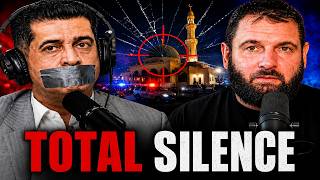
When a social media provocateur known as “Chud the Builder” armed himself with bear mace and a pistol, drove to Black communities across America, and began hurling racial slurs under the banner of “free speech,” the situation was never really about speech at all. It was a calculated attempt to provoke violence — and as Dr. Hassan explained in this episode of The Deen Show, what happened next was entirely predictable: Chud the Builder shot someone outside a courthouse in Montgomery County and wounded himself in the process, now facing attempted murder charges with a $1 million bond. The incident has ignited urgent conversation about where free speech ends and hate speech begins — and Islam, with its comprehensive ethical framework for human communication, offers clarity that cuts straight through the noise.
Free Speech, Hate Speech, and the Intent Behind the Words
The Chud the Builder situation is a case study in what happens when provocateurs misuse the language of civil liberties. His method was deliberate: approach people in Black communities, ask if they believe in free speech, receive agreement — and then unleash racial slurs while armed and ready for conflict. Dr. Hassan was direct in his assessment: “He was seeking attention. He was seeking to provoke the people. And he was actually seeking violence, not free speech.” Hate speech is not merely offensive language — it is speech that is designed to provoke physical confrontation, to dehumanize, and to ignite the kind of racial strife that some, troublingly, see as a path to political power. The fact that Chud arrived at each encounter loaded with weapons was itself the confession of intent. No one enters a “conversation” with bear repellent and a pistol unless they already know what their words are going to trigger.
- Hate speech is defined not just by its content but by its intent — speech engineered to provoke confrontation is not protected expression, it is a weapon
- Chud the Builder’s self-wounding during the shooting underscored the recklessness and ultimate futility of racial provocation
- Historical patterns of government-sanctioned racial destabilization — from the CIA’s documented role in flooding Black communities with drugs and guns — make conspiracy theories about coordinated provocateurs less far-fetched than they might seem
- People of all faiths, Dr. Hassan noted, can see through this agenda — but those who already carry hatred in their hearts will rally to support it regardless
- Arriving to a public “speech” encounter with armed weapons signals premeditation, not principle
“It is only going to be used as fire to burn our communities down. That means a Muslim is not allowed to insult a non-Muslim. Allah has honored every single child of Adam, black or white.” — Dr. Hassan
What the Quran and Sunnah Say About Insult, Racism, and the Human Tongue
Islam’s position on speech like Chud the Builder’s is not ambiguous — it is settled, clear, and rooted in divine command. In Surah Al-Hujurat (Chapter 49), Allah commands: “Ya ayyuhallazina amanu la yaskhar qaumun min qaumin” — “O you who believe, do not insult one another” — with the profound caveat that perhaps the one you are insulting is better than you. Critically, this is not an in-group rule. When Allah says in the Quran “Wa laqad akramna bani Adam” — “Indeed, We have honored the children of Adam” — He does not say “We have honored the Muslim community.” Every human being, black or white, believer or non-believer, carries an innate dignity granted by the Creator, because every soul carries the potential to return to Allah. Furthermore, in Surah Al-An’am (Chapter 6), Allah even forbids Muslims from cursing the false gods of polytheists — not because those gods deserve respect, but because insults provoke retaliation and cause people to curse Allah in ignorance. And the Prophet Muhammad ﷺ extended this ethic to all humanity: “Whosoever believes in God and the Last Day, let them say a word that is good or remain silent.” Islam does not merely discourage harmful speech — it builds an entire ethical architecture around the sanctity of the tongue.
Silence Is Golden: Islam’s Spiritual Framework for Guarding the Tongue
Islamic scholars have long taught that the tongue is among the most dangerous weapons a human being possesses — so dangerous, in fact, that Allah sealed it behind two rows of teeth and two sets of lips while leaving every other sense exposed to the world. The Prophet ﷺ warned that a person may utter a single word without thinking, and because of that word, the anger of Allah descends upon them and they fall into the depths of the Fire. The inverse is equally powerful: a single good word, spoken with sincerity, can elevate a person to the heights of paradise. Our mother Aisha, may Allah be pleased with her, described the Prophet ﷺ as someone whose words you could count on your hands — deliberate, specific, never wasteful. Islamic scholars distilled this wisdom into a maxim: if speech is silver, then silence is gold. The Day of Judgment, Islam teaches, will include not just the weighing of deeds but the weighing of our speech itself. Every careless word, every racial slur deployed for likes and followers, every provocation designed to humiliate — none of it escapes the record.
“A person may throw a word giving no thought to it, just throw it out of their mouths. But because of it, the punishment and the anger of Allah comes down upon them, and it will cause them to fall into the depths of hell. Silence is a shield.” — Dr. Hassan
The case of Chud the Builder is ultimately not just a story about one man’s racist provocations — it is a mirror held up to a society wrestling with the abuse of liberty and the consequences of speech detached from moral accountability. Islam’s answer is not censorship, but consciousness: a deep awareness before the Creator that every word carries weight, that every human being carries honor, and that the believer’s conduct must reflect the guidance of Allah even when — especially when — the world around them is on fire. As Muslims, we are not called to match hatred with hatred or slur with slur. We are called to embody the prophetic model: measured in speech, dignified in character, and unwilling to let the provocations of others drag us away from the straight path. The Quran, as Eddie noted on The Deen Show, settles the debate for those who hold it as their instruction manual — and its guidance is a mercy not just for Muslims, but for all of humanity.